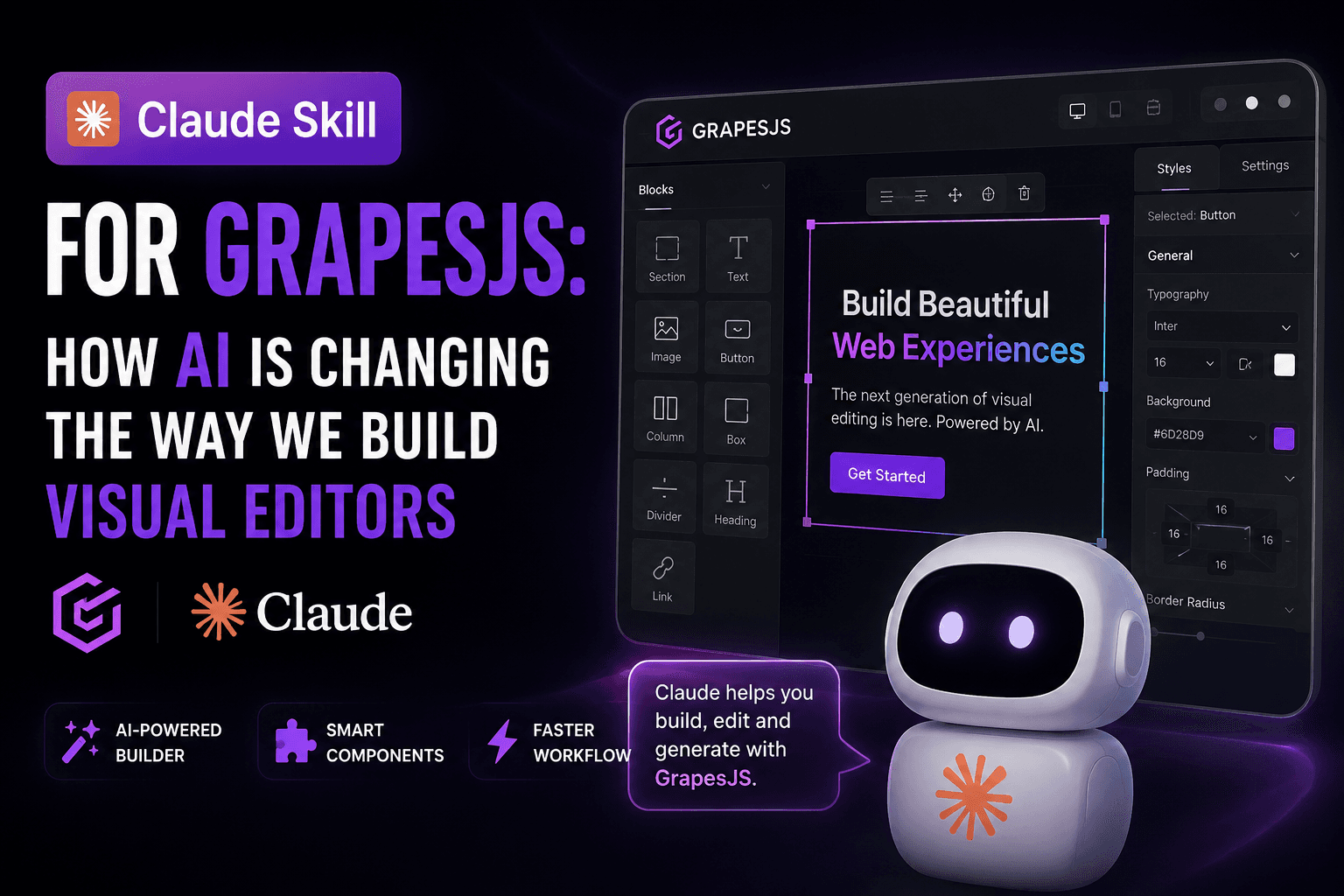

We've released the Claude Skill for GrapesJS Development— a free, open-source skill that turns Claude into a developer who actually knows GrapesJS. It lives on GitHub under MIT, works with 0.21.x, 0.22.x and 0.23.x, and is compatible with GrapesJS Studio. Here's why we built it, what actually changes in day-to-day work, and where we think this is heading.
The problem was never that AI can't write code
Any modern model writes perfectly good JavaScript. GrapesJS has a different problem: it's a framework with a large, specific API surface that isn't especially well represented on the open internet.
The component model withdefaults,traits,isComponent, customviewandmodel. The Block Manager and itscontentsemantics. Commands and their lifecycle. The Style Manager with its sectors and properties. Storage Manager. Asset Manager. Device Manager. RTE extensions. CSS Composer. Dozens of editor events.
If a model has mostly seen React and Express, its knowledge of GrapesJS is shallow — and it will confidently invent APIs that don't exist. You know the pattern: the code looks immaculate, imports cleanly, then breaks. Becauseeditor.addBlock()isn't a thing in that shape, and what you actually needed waseditor.BlockManager.add().
The old workaround was manual: re-explain the architecture in every new chat, paste chunks of documentation, then clean up the hallucinations. That took longer than writing the code yourself.
What the Skill does
A Skill is a structured package of domain knowledge and conventions that Claude pulls in when it recognises the task is a GrapesJS one. Not a 200-line system prompt you copy into every conversation — knowledge that lives alongside the model and activates on its own. In practice this means you stop explaining the framework and start describing the feature:
Create a GrapesJS plugin that adds a pricing table block with editable plans.
Create a custom Trait that lets users pick an icon from a predefined collection.
Add a new Style Manager sector for CSS Grid controls.
Build a React component that initialises GrapesJS with this plugin architecture.
What comes back follows ecosystem conventions: the correct plugin signature, proper component registration, TypeScript types, a sane file structure.
The Skill covers plugins, components, blocks, traits, commands, panels and buttons, Style Manager and RTE extensions, Storage and Asset Manager integrations, Device Manager, CSS Composer utilities, Undo Manager, canvas extensions — plus everything around them: React, Vue, Next.js, Laravel backends.
What actually changes
The barrier to entry drops. Your first GrapesJS plugin usually costs two days of reading docs and other people's source. Now you can start from a working skeleton and learn as you go, rather than before you go.
Boilerplate compresses. Blocks, traits, panels — code you've written a hundred times with small variations. That's exactly the kind of work that delegates well.
Prototypes get cheap. "What if we built a custom email builder?" stops being a week-long commitment just to test the idea. Half an hour and you have something to show.
The bottleneck moves. It used to behow do you even do this in GrapesJS. Now it'swhat are we building and how should it feel to use. That's a more interesting problem to be stuck on.
What the Skill doesn't do
Worth saying plainly, because expectations around AI tooling tend to run hot.
It doesn't replace understanding the framework.It shortens the path to working code, but debugging complex canvas behaviour, dealing with performance on large documents and making architectural calls are still yours.
It doesn't guarantee correctness.The model can still get things wrong, especially across version boundaries or in rarely used APIs. Review it like you'd review any other developer's pull request.
It doesn't replace well-built plugins.A block generated in a minute and a plugin hardened across hundreds of real projects are different objects. The first is great for prototypes and internal tools; the second is what you want in production you'll maintain for years.
Where this is going
The Skill is a first step. The interesting part comes after.
Agents that can see the editor.Right now AI writes blind: it generates a plugin, you run it, you look, you come back and describe what broke. The obvious next step is giving the agent access to editor state — so it opens the preview itself, notices the block collapsing on mobile, and fixes the CSS. Technically, everything needed for this already exists.
AI inside the builder, not just in building it.The Skill helps you make an editor. But the same knowledge layer belongs inside the product: a user describes a section in plain language and the editor assembles it fromyourblocks, respectingyourdesign system. The gap between "AI generates HTML" and "AI operates your components" is the whole ballgame — and only the second version makes sense in a commercial builder.
Plugins assembled per project.A marketplace today means finished solutions you adapt. Next comes the hybrid: a base plugin plus generation for whatever's missing in your specific case. We already run a plugin generator, and it points the same direction.
Skills as a distribution format for expertise. If knowledge about a framework can be packaged and shared, why stop at frameworks? A skill for a specific plugin. For a company's design system. For one client's email-template rules. We think this becomes a normal companion to documentation.
FAQ
What is the Claude Skill for GrapesJS?
It's a free, open-source skill that gives Claude structured knowledge of the GrapesJS API — components, blocks, traits, commands, panels, Style Manager, Storage and Asset Manager — so it generates code that follows ecosystem conventions instead of inventing methods that don't exist.
Which GrapesJS versions does it support?
The skill is tested with GrapesJS 0.21.x, 0.22.x and 0.23.x, and it's compatible with GrapesJS Studio.
Is it free for commercial projects?
Yes. It's released under the MIT license and free for both personal and commercial use. The source is on GitHub and open to contributions.
Do I need to know GrapesJS to use it?
It helps, but it's no longer a prerequisite for getting started. The skill will hand you a working plugin skeleton on your first try — you can learn the architecture by reading and modifying it rather than by reading docs for two days first. For anything beyond prototypes, you'll still want to understand what the code does.
Does it work with React, Vue or Next.js?
Yes. Beyond core GrapesJS APIs, the skill covers integration patterns for React, Vue and Next.js, along with backend wiring such as Laravel for storage and asset handling.
How is this different from just asking an AI about GrapesJS?
Without domain context, models tend to hallucinate GrapesJS APIs — plausible-looking calls that don't exist in any version. The skill supplies the real API surface and conventions up front, so you spend your time reviewing code rather than correcting invented methods.
Getting started
The Skill is free, open source, MIT — personal and commercial use, no strings.
Pull requests, ideas and bug reports are all welcome. The GrapesJS ecosystem has always run on people sharing what they built for themselves — this is one more of those.
If you try it and something goes sideways, open an issue. We're genuinely curious what you'll build with it.