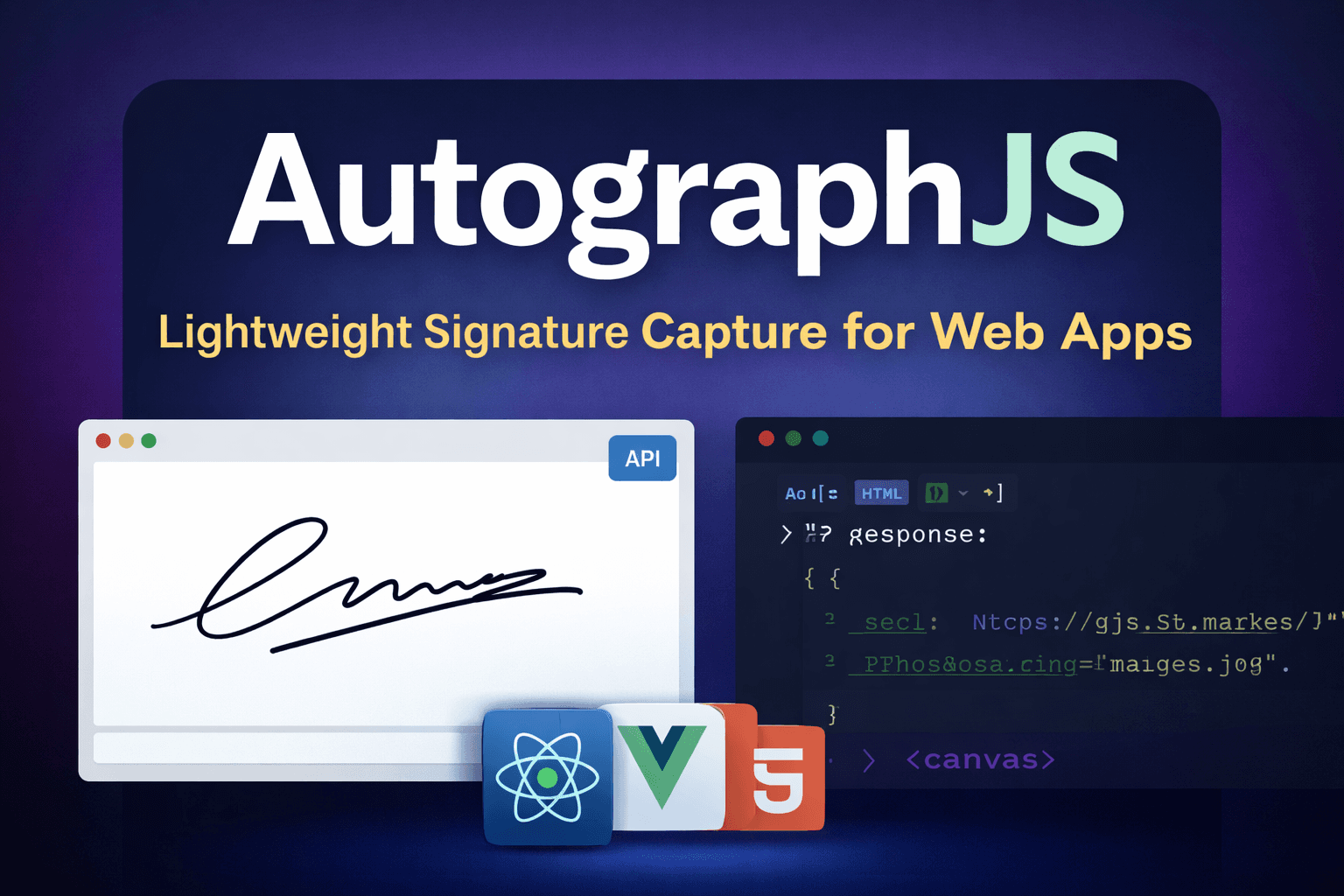

In modern web applications — especially document builders, form systems, and visual editors — signature capture is still often treated as a custom feature.
Developers usually face the same challenges:
- Rebuilding canvas drawing logic
- Handling touch + mouse input correctly
- Exporting clean images
- Sending signatures to APIs
- Making it work across frameworks
This becomes even more visible inside visual builders like GrapesJS, where users expect advanced document functionality out of the box.
Why a Lightweight Approach Matters
Most existing signature solutions fall into two categories:
Heavy libraries
Large bundle size, over-engineered features.
External SaaS tools
Extra cost, API limits, external dependencies.
For editor ecosystems and plugin marketplaces, developers often need something:
- Small
- Flexible
- Framework-agnostic
- Easy to embed into existing UI
Introducing a Minimal Signature Capture Approach
The goal was simple:
Make signature capture behave like a native UI component, not a separate system.
Key design principles:
✅ Canvas-first rendering
✅ Clean image export
✅ API-ready output
✅ Framework-neutral core
✅ Easy embedding into editor environments
This makes it especially useful for:
- Document builders
- Contract platforms
- Form SaaS products
- Visual editors
- No-code / low-code tools
Real Use Case: Visual Editor Integrations

Inside visual builders, signatures are often part of larger workflows:
- Document templates
- Dynamic variables
- User-generated content
- Export pipelines
In environments similar to the ecosystem around GitHub open-source projects, developers benefit most from modular, drop-in solutions rather than monolithic SDKs.
Where This Fits in the Editor Ecosystem
For marketplaces and plugin ecosystems, lightweight signature capture unlocks:
- Document signing workflows
- Form completion experiences
- Customer onboarding flows
- Contract preview + sign systems
Without forcing developers to adopt large dependencies or external services.
Future Direction
The next step for signature tooling in web editors is likely:
- Variable-aware signatures
- Multi-device input optimization
- Real-time collaboration scenarios
- Built-in document workflow integrations
Discussion
I’m especially interested in feedback from developers building:
- Visual editors
- Document generation tools
- Form builders
- SaaS platforms handling user documents
How are you currently solving signature capture?
Custom canvas? Third-party service? Something else?
Project AutographJS propose the best solution for that, look:
✍️ Capture Real Signatures. Ship Faster.
Modern web apps handle documents, forms, and contracts —
but signature capture is still surprisingly painful to implement.
You usually have to deal with:
• Canvas drawing logic
• Touch + mouse input handling
• Image export pipelines
• API upload flows
• Framework compatibility
So this project was built to make signature capture simple, lightweight, and production-ready.
🚀 What This Project Does
A lightweight JavaScript solution that lets you:
✅ Capture handwritten signatures in browser
✅ Export as clean image
✅ Send directly to API
✅ Integrate in minutes
✅ Work across frameworks
Built for real production use in:
- Document platforms
- Form builders
- Contract SaaS
- Visual editors
- No-code / low-code tools
🧩 Built for Modern Stacks
Works smoothly with:
- React
- Vue
- Vanilla JS
- Editor environments
- Custom UI systems
No heavy dependencies. No external SaaS required.
🌍 Why It Exists
Signature capture is still rebuilt from scratch in many projects.
The goal here was simple:
Make signature capture feel like a native UI component, not a separate system or service.
GitHub: https://github.com/GoodPHP/AutographJS
💬 Feedback Welcome
If you build:
- Document tools
- Editors
- Form platforms
- SaaS products handling user data
I’d love to hear:
👉 How do you handle signatures today?
👉 Custom build or third-party service?
👉 What’s the biggest pain point?